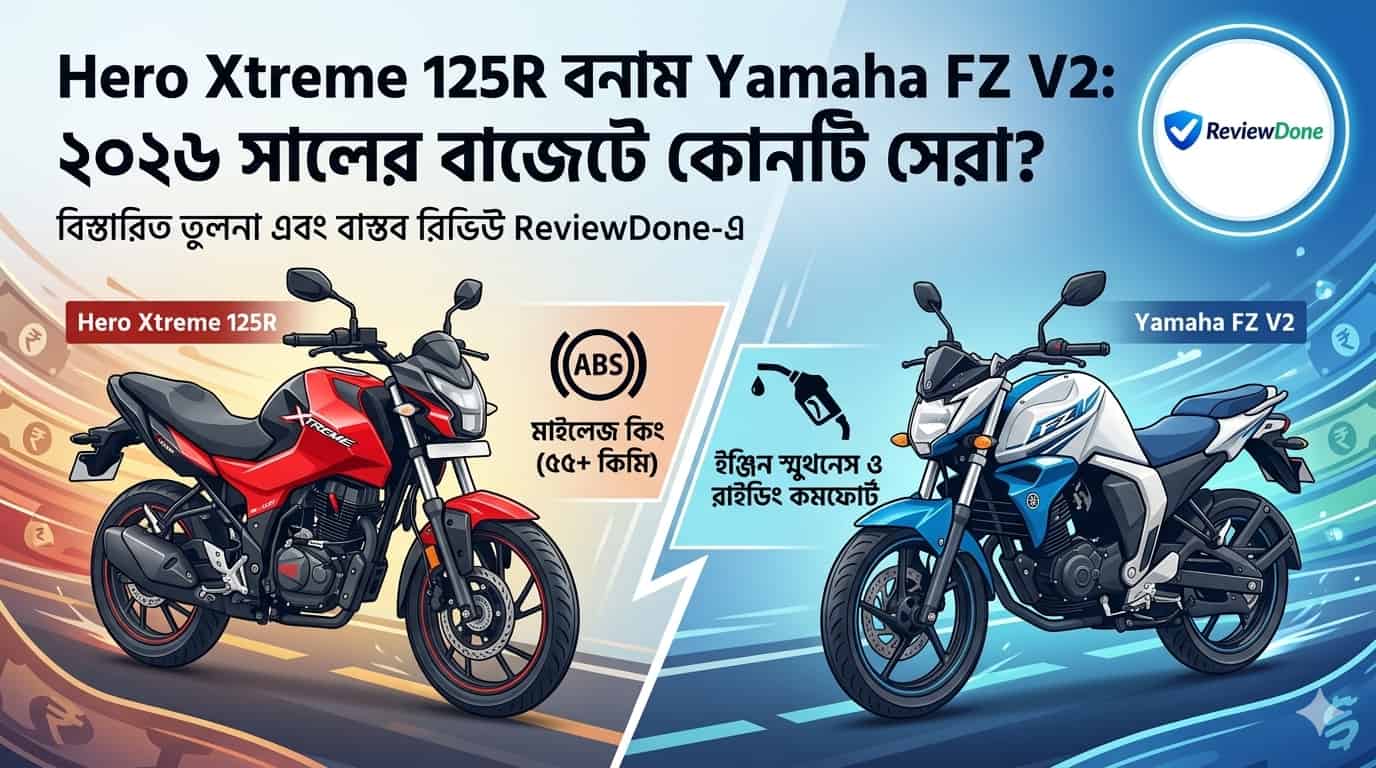
Yamaha FZ V2:
Still the King of the Streets in 2026?
Muscular tank, buttery gearbox, and a mileage figure that keeps your wallet happy — here's everything you actually need to know before you swing a leg over the FZ V2.
Walk into any showroom, scroll through any owners' group, or just stand at a busy intersection during rush hour — the Yamaha FZ V2 (badged FZS Fi V2 in some markets) is everywhere, and for good reason. Even as Yamaha rolls out newer V3 and V4 versions with ABS and flashier LED work, the "Version 2" refuses to fade into the background. It has quietly become one of the most trusted 150cc commuter-sport motorcycles on the road, and this review breaks down exactly why.
Quick Specs at a Glance
| Engine | 149cc, Air-cooled, SOHC, Fuel Injected (Blue Core) |
| Max Power | 13 BHP @ 8,000 rpm |
| Max Torque | 12.8 Nm @ 6,000 rpm |
| Gearbox | 5-Speed Manual |
| Mileage | 40–45 kmpl (claimed) |
| Kerb Weight | 133 kg |
| Brakes | Front & Rear Disc, Tubeless Tyres |
| Top Speed | ~115–120 km/h |
Figures are manufacturer-claimed and vary slightly by market and trim.
Design & Build Quality
The FZ V2's signature is its muscular, bull-like fuel tank — a design language Yamaha has carried through multiple generations because it simply works. The wide handlebar, upright seating posture, and broad tyres give it a stance that looks heavier and more aggressive than its actual weight class suggests. Add the multi-reflector halogen headlamp, sculpted air-scoops, and a fully digital speedometer with a rev-counter and fuel gauge, and you get a motorcycle that still doesn't look dated years after launch.
Build quality is where Yamaha quietly wins. Panel gaps stay tight, paint holds its shine, and plastics resist the rattling that plagues cheaper commuters after a few thousand kilometers on rough roads. It's a big reason the FZ V2 continues to command strong resale value in the used bike market.
Engine, Ride Quality & City Performance
Under the tank sits a 149cc, fuel-injected, air-cooled engine producing roughly 13 BHP and 12.8 Nm of torque. On paper that's modest for the segment, but the FZ V2 was never built to chase peak numbers — it was engineered to make every one of those horses usable in real traffic. Fuel injection means crisp throttle response, easier cold starts, and none of the flat spots you'd get from a carbureted engine.
The 5-speed gearbox is one of the smoothest in its class — light clutch pull, precise shifts, and a forgiving neutral-finder that makes stop-and-go traffic far less tiring. At 133 kg, the bike is light enough to filter through congestion but planted enough at highway speeds not to feel twitchy. The telescopic front forks and monoshock rear keep things composed over broken tarmac, and the front-rear disc combination delivers confident, predictable braking — a genuine highlight riders consistently praise.
Mileage & Running Costs
This is the FZ V2's strongest selling point. Real-world owners consistently report 40–45 kmpl in mixed city and highway riding, thanks to the Blue Core fuel-injection system optimizing the air-fuel mix in real time. Maintenance is equally wallet-friendly: routine parts like brake pads, air filters, and clutch cables are inexpensive and widely available, and an oil change every 1,500–2,000 km keeps the engine running smoothly for the long haul. For daily commuters and students watching their monthly budget, this combination of low fuel burn and cheap upkeep is hard to beat.
Pros & Cons
What Works
- + Excellent fuel efficiency for the segment
- + Confident, predictable braking
- + Smooth, refined 5-speed gearbox
- + Strong build quality & resale value
- + Iconic, muscular street-naked styling
Where It Falls Short
- − Power output trails some rivals in class
- − No ABS on the standard V2 trim
- − Overtaking with a pillion needs planning
- − Headlamp brightness is average at night
Who Should Buy the Yamaha FZ V2?
If your priority list reads "reliable daily commuter, low running cost, strong resale, and a bike that still turns heads," the FZ V2 checks every box. It's an easy recommendation for first-time riders, college students, and office commuters who want a naked street bike without the maintenance headaches or fuel bills of a full-blown performance machine. Riders chasing outright power or factory-fitted ABS may want to look at the newer FZ V3 or V4 instead — but for pure value-for-money, the V2 remains a benchmark.
Frequently Asked Questions
Is the Yamaha FZ V2 good for long highway rides?
Yes — the riding position and stable chassis make it comfortable over long stretches, though its modest power means overtaking at high speed needs more planning than on higher-cc bikes.
How often should I service the FZ V2?
An oil change every 1,500–2,000 km, paired with a general checkup every 3,000–4,000 km, keeps the engine and drivetrain in top shape.
Does the FZ V2 come with ABS?
The standard FZ V2 relies on a front-rear disc brake setup without ABS. Riders wanting ABS should consider Yamaha's higher V3/V4 trims.
Final Verdict
Years after its launch, the Yamaha FZ V2 still makes a compelling case for itself. It isn't the most powerful bike in its class, nor the most feature-loaded — but it nails the fundamentals that matter most to everyday riders: reliability, fuel economy, braking confidence, and a design that has genuinely aged well. For anyone shopping the 150cc street-naked segment on a sensible budget, the FZ V2 is still very much worth a test ride.